 Visit Porto City Guide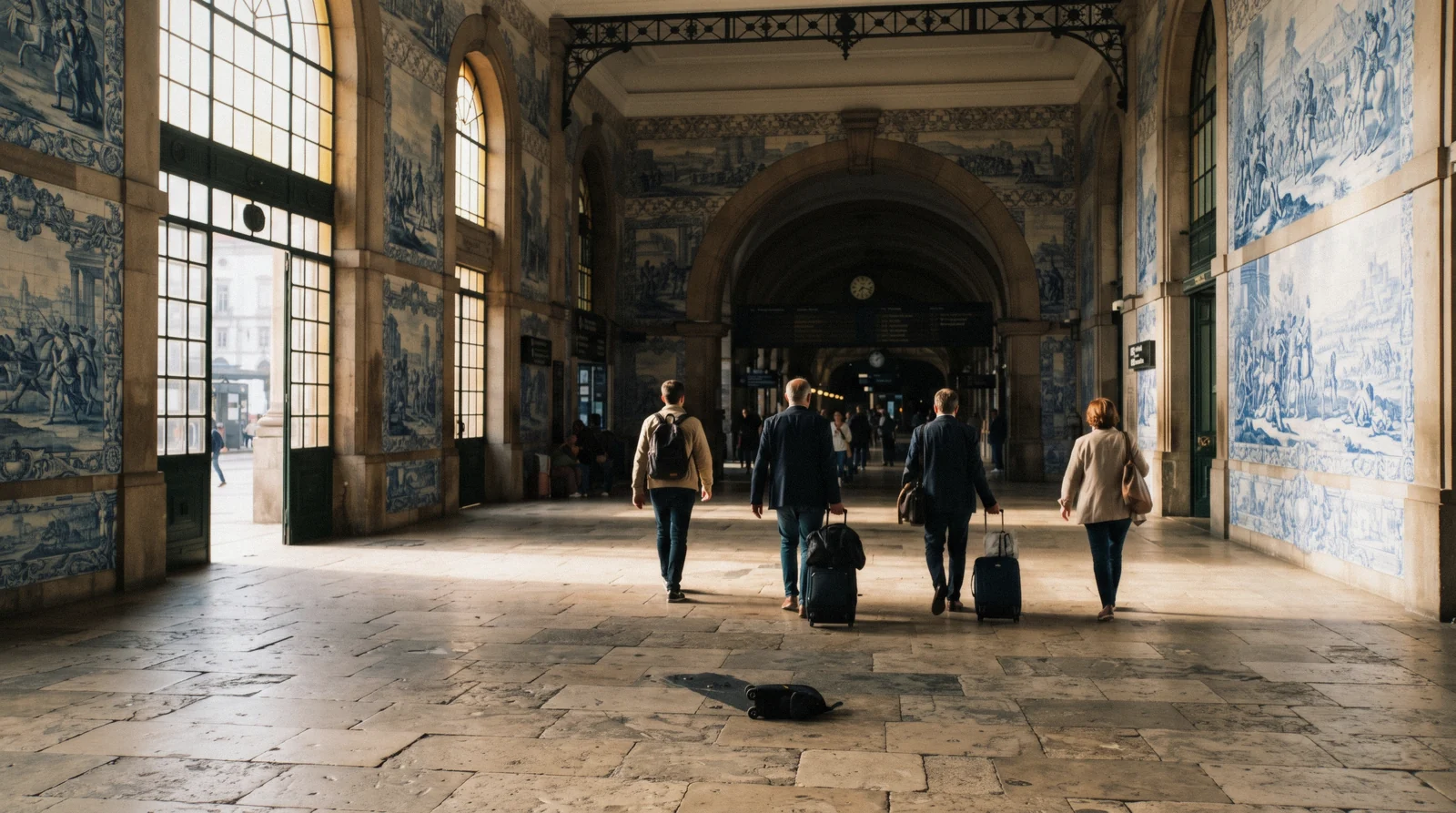
São Bento Station
São Bento station is a working railway terminus whose entrance hall is covered in about twenty thousand painted tiles — battles, royal entries, harvests and a frieze of every way the Portuguese have moved since the ox-cart — and it costs nothing to stand in it, because it is a station. This page explains what the panels show, when the hall is empty enough to see them, which trains actually leave from here and which need the four-minute shuttle to Campanhã, where the lockers are and how the metro connects. The walks that stop here are on the Porto tours hub; the cathedral three minutes uphill is on the Sé page; for the rest of the city, see things to do in Porto.
Quick answer Free, twenty thousand tiles, which trains leave from here, and when the hall is empty — the four facts that decide the visit
São Bento station is free to enter at any hour trains are running; the entrance hall carries about twenty thousand azulejo tiles by Jorge Colaço, installed between 1905 and 1916, showing the Battle of Valdevez, Egas Moniz, the entry of João I and Philippa of Lancaster into Porto in 1387 and the conquest of Ceuta in 1415. The station serves the Douro, Minho, Braga, Guimarães and Aveiro lines; Lisbon trains use Campanhã, four minutes away by a shuttle that is free with your mainline ticket.
Key takeaways
- See the tiles before 09:00 or after 18:00; between those hours every walking tour in the city stops in the vestibule, and the lower panels are behind a group most of the day
- For the Douro line, buy at the São Bento windows: the InterRegional to Pinhão is $14.47 (€12.45) from here, and the Douro Valley page compares the train with the day trip with lunch and boat that most people book instead
- Three of the most-booked old-town walks name the station as a stop — the walk from the Lions Fountain explains the panels, the small-group walk capped at eight starts nearby — and the Sé is three minutes uphill for a $3.49 (€3) cloister ticket
Key facts
Opening hours
| Concourse, daily | Not stated by CP–Open with the trains |
|---|
Closed None; a working station every day of the year
Admission
- Adult
- Free to enter the hall
- Reduced
- Train fares: urban lines from $1.92 (€1.65); Douro line Regional to Régua $11.74 (€10.10), InterRegional to Pinhão $14.47 (€12.45)
- Free
- Everyone, always; the tiles are in the public vestibule before any ticket gate
Planning it
- Time needed
- Not stated by anyone; our routing: 15 minutes for the panels, 25 with the frieze and the platforms
- Book ahead
- Optional — walk-up usually fine
- Address
- Praça de Almeida Garrett, 4000-069 Porto
There is no ticket for the tiles; the vestibule is the public concourse of a CP station. What the table compares, priced in Q3 2026 from cp.pt and GetYourGuide and converted at €1 = $1.1622, is the free door against the three walking tours that stop in the hall and explain the panels — the only paid way to have the tiles narrated, since the station runs no tours of its own.
Do you want to look at the tiles, or to be told what they show? Looking is free at any hour; the telling comes with a walk that covers the rest of the old town too.
| Option | Price | Includes | Cancel | Book |
|---|---|---|---|---|
| The station hall, CPEveryone; come before 09:00 and the hall is yours | Free | The vestibule, the panels, the frieze and the platforms behind them; no guide, no time limit | — | Official site |
| City highlights walk from the Lions Fountain, 2.5 h, EnglishThe cheapest scheduled walk that lists the tile panels as a stop | $17.43 (€15) | Guide with a white umbrella; the São Bento tiles explained, viewpoints, old town; 4.7 from 289 reviews | Free up to 24 hours before | Check Availability |
| Highlights and hidden gems walk, max 8 people, 2.5 h, English or GermanA small group that can stand in front of one panel while the guide talks | $33.70 (€29) | São Bento and the Clérigos tower on the route, restaurant list at the end; 5.0 from 496 reviews | Free up to 24 hours before | Check Availability |
| Walking tour with Lello, boat and cable car, 3–4 hA first day that wants the station, the river and the cable car in one booking | $69.70 (€60) | Guided walk past São Bento, a Douro cruise and the Gaia cable car; Lello entry on some options; 4.7 from 1,279 reviews | Free up to 24 hours before | Check Availability |
The three-hour guided tour with entry tickets sold on the platform visits the São Bento da Vitória monastery — a different São Bento, a Benedictine monastery ten minutes uphill in Vitória — not this station. The names trip people up; the station was built on the site of a third São Bento, the convent of São Bento de Avé-Maria, demolished in 1892.
São Bento station: the walks that stop in the hall
Every card links to the operator's own page, where the calendar shows what is still open on your date. Prices in dollars as listed in Q3 2026; all three name the station on their route, none needs a ticket for it.
 from €15
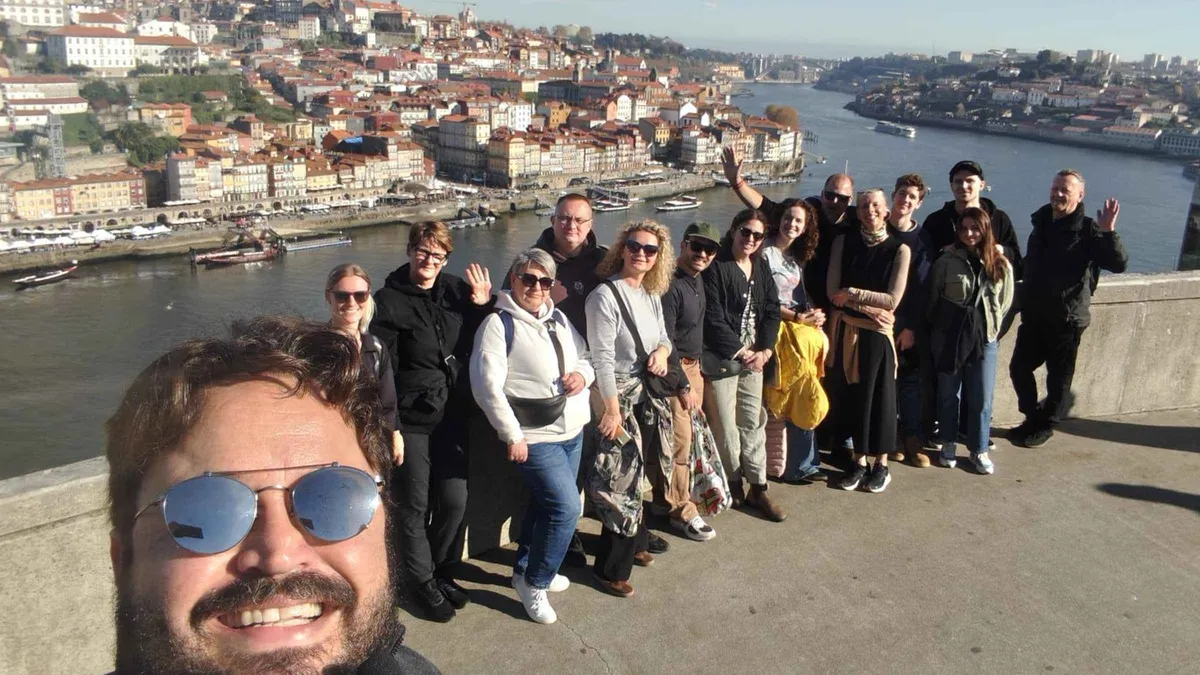
Porto: City Highlights Guided Walking Tour
listed at $17.42
A two-and-a-half-hour English walk from the Lions Fountain with a guide under a white umbrella. The cheapest scheduled walking tour on this page, from the Hi Lisbon team's Porto branch.
Check Availability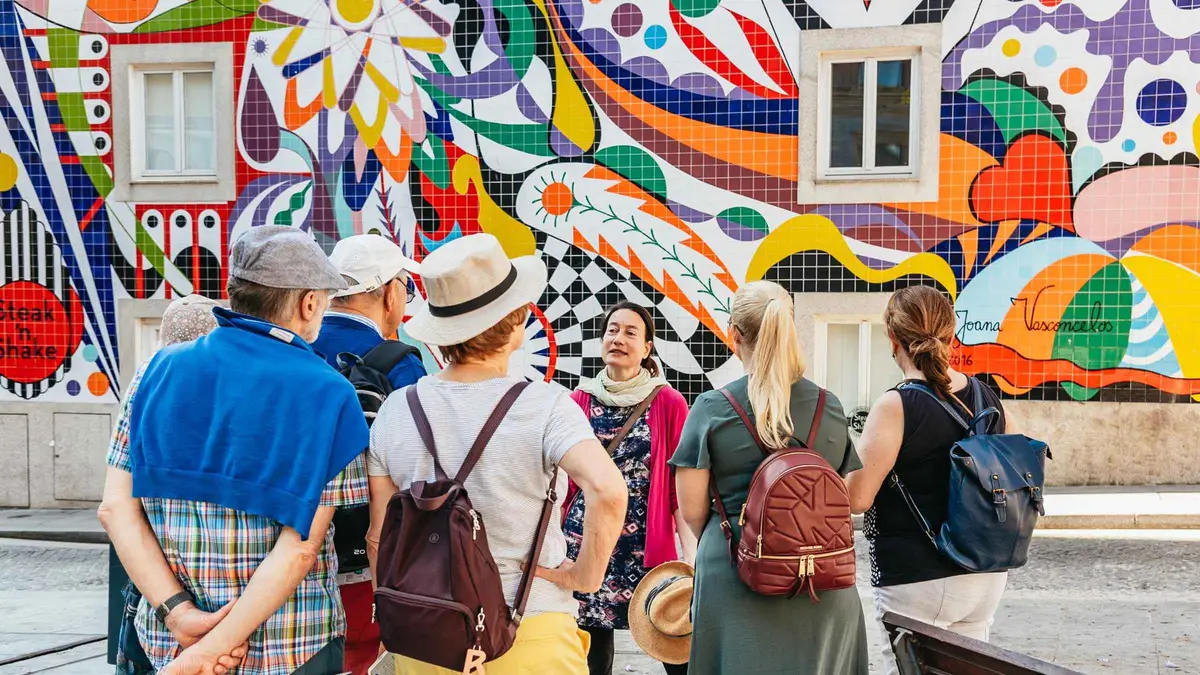 from €29
Porto Walking Tour: Highlights & hidden gems - max 8 pax
listed at $33.68
A capped-at-eight walk in English or German with restaurant recommendations written down at the end. The best-rated small-group walk here, with a two-person minimum to run.
Check Availability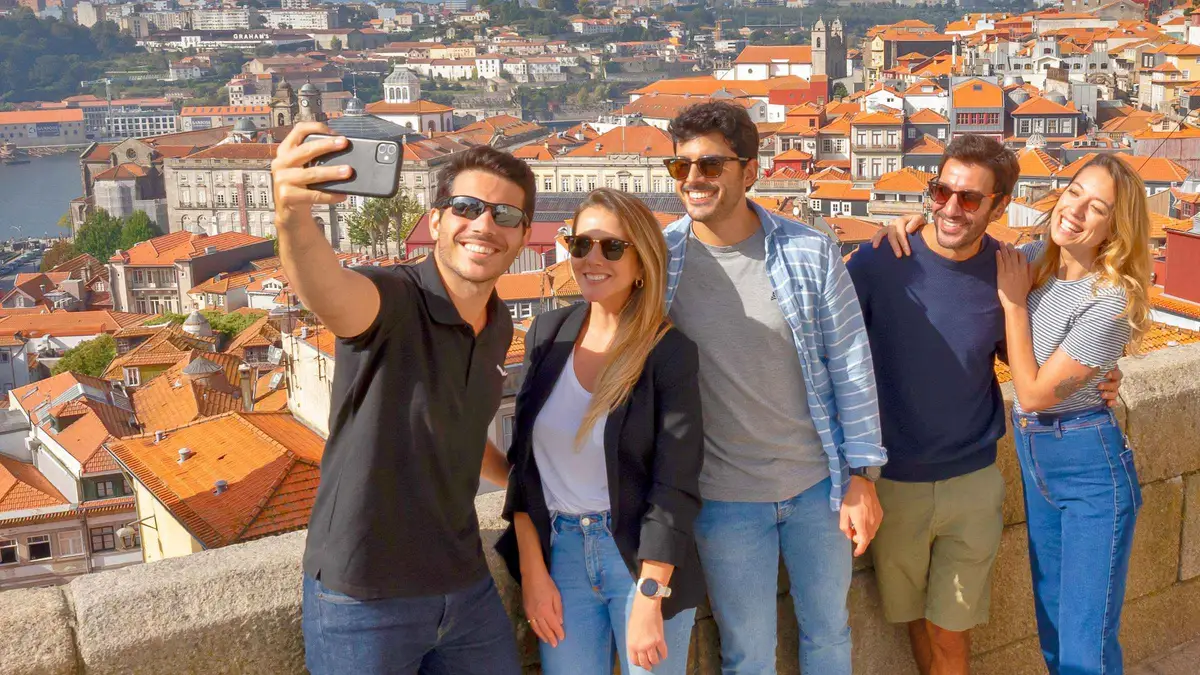 from €60
Porto: Walking Tour, Lello Bookshop, Boat and Cable Car
listed at $69.67
A guided walk that folds in the Gaia cable car ride and a Douro river cruise, with Lello entry as an option. Suits a first day when you want the three riverside set pieces handled in one booking.
Check Availability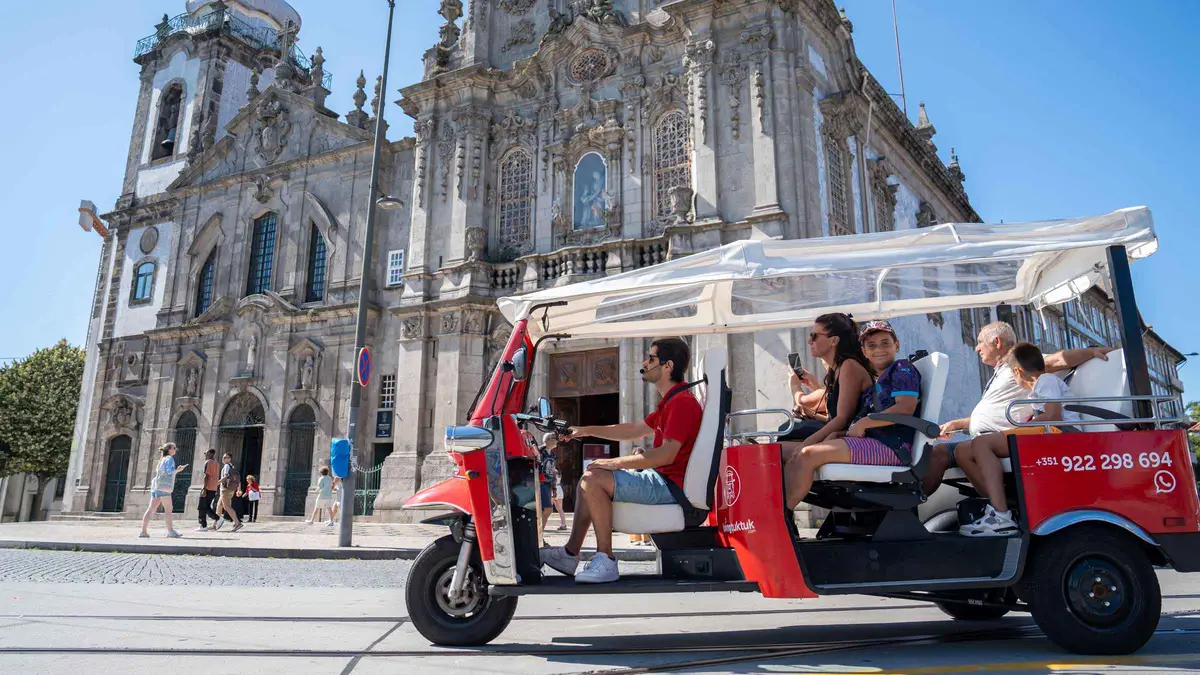 from €25
Porto: Guided Tour by Tuk-Tuk & Optional Douro River Cruise
listed at $29.03
A 50-minute electric tuk-tuk loop through the centre, with an open-dated Six Bridges cruise ticket on the combined option and a walking-tour voucher for the next day. Shared bookings may be split across several tuk-tuks.
Check AvailabilityPrices, ratings and details are the platform's own. Dollar figures are the listed prices. The platform bills in your account's currency.
The São Bento station tiles: what each panel shows
About twenty thousand tiles, 551 square metres, painted by Jorge Colaço and fired at the Sacavém factory between 1905 and 1916 — the figures from the station's Wikipedia entry and from Visit Portugal's listing, read in Q3 2026. The hall is small enough to read in a quarter of an hour once you know where to look.
The two great panels: Valdevez and Ceuta
The largest compositions face each other across the vestibule. On one side is the Battle of Valdevez of 1140 — properly the tournament of Valdevez, the joust between Portuguese and Leonese knights that stood in for a battle in the year Afonso Henriques was claiming a crown; Colaço paints two groups of antagonists with more knights behind. Opposite it is the conquest of Ceuta in 1415, the expedition that opened the Portuguese century of expansion, with the young Infante Dom Henrique — Henry the Navigator, whose statue stands in the garden in front of the Palácio da Bolsa — as the principal figure.
Both are in the blue-and-white that Colaço made the house style of Portuguese public tiling.
Egas Moniz and the royal entry of 1387
Two smaller history panels. Egas Moniz, tutor to Afonso Henriques, presents himself with a rope around his neck before Alfonso VII of León, offering his life for a broken oath he had sworn on his pupil's behalf — the founding story of Portuguese honour, and the panel most guides stop at. The other shows João I and Philippa of Lancaster entering Porto in 1387, the year they married in the cathedral three minutes uphill; the couple's son was the Infante Dom Henrique of the Ceuta panel opposite, which is the hall's one piece of narrative design.
The ethnographic scenes and the transport frieze
Below the history, at eye level, run scenes of Portuguese regional life — the Douro harvest, a pilgrimage, a river fair, windmills, the cattle market — in the same blue and white. Above everything, under the cornice, a polychrome frieze traces the forms of transport used across Portugal in chronological order, from the ox-cart and the litter to the horse tram and, at its end, the steam locomotive that the station was built for. It is the part most people miss because it is the part above their heads; stand in the centre of the hall and turn slowly.
São Bento station history: a convent, a king and a sixteen-year build
Dates from the station's Wikipedia entry and Visit Portugal's listing, read in Q3 2026. The building is a decade older than its decoration.
The site was the convent of São Bento de Avé-Maria, a Benedictine nunnery that gave the station its name and was demolished in 1892 to make way for it. King Carlos I laid the first stone in 1900. The architect was José Marques da Silva, Porto's great Beaux-Arts practitioner, trained in Paris, who gave the city a French station front — mansard roofs, a pedimented centre, tall arched windows — on the square that also carries Almeida Garrett's name. The tiles came later: Colaço's panels were made between 1905 and 1916, and the station was inaugurated in 1916, sixteen years after the king's stone.
It was never the main-line terminus. Campanhã, east of the centre, took the Lisbon expresses from the start, and São Bento's role was and is the northern and eastern regional lines — Minho, Douro, Braga, Guimarães — and the urban trains, with the four-minute shuttle from Campanhã bringing the long-distance passengers into town. Metro line D reached the square in 2005 underneath it. The building is a National Monument inside the UNESCO Historic Centre of Porto, listed in 1996 with the Luís I bridge and the Serra do Pilar monastery.
Which trains leave from São Bento, and which need Campanhã
Fares are the CP 2026 tariff, valid from 1 January 2026, read on cp.pt in Q3 2026 and converted at €1 = $1.1622. Journey times are not printed on CP's station page and are not given here.
The rule is simple once said: São Bento is for the north and the Douro, Campanhã is for Lisbon and Spain. The Douro line — Régua, Pinhão, Tua, Pocinho — starts here, and it is the one most visitors use; Regional trains run only as far as Régua, and Pinhão needs the InterRegional. The Minho line to Viana do Castelo and Valença, the Braga and Guimarães branches and the Aveiro urban line all serve São Bento, though many of those trains also call at Campanhã.
The Alfa Pendular and Intercidades to Lisbon, Coimbra and the Algarve, and the Celta to Vigo, leave from Campanhã only; a Lisbon ticket includes the São Bento–Campanhã shuttle, which runs every five to fifteen minutes and takes four minutes, free with your mainline ticket within an hour of arrival — the practical detail from seat61's Porto page, since CP's own station page prints nothing. The Porto to Lisbon page has the express fares and the Douro Valley page the line's stations.
| Destination | From | Train | Fare (2026) |
|---|---|---|---|
| Régua (Douro) | São Bento | Regional / InterRegional | $11.74 (€10.10) / $12.90 (€11.10) |
| Pinhão (Douro) | São Bento / Campanhã | InterRegional only | $14.47 (€12.45) / $14.35 (€12.35) |
| Pocinho (end of the line) | São Bento | InterRegional | $17.55 (€15.10) |
| Braga, Guimarães, Aveiro | São Bento | Urban (zone fare) | From $1.92 (€1.65) for 1–2 zones; zone count to each town not stated on the poster we could read |
| Lisbon | Campanhã (shuttle from São Bento, 4 min) | Alfa Pendular / Intercidades | $41.50 (€35.70) / $32.60 (€28.05) |
Buying a ticket
The ticket windows and machines are in the hall to the left of the vestibule as you face the platforms; the six platforms are numbered one to six from left to right. Douro-line tickets for a specific day sell out on summer weekends — the InterRegional carries most of the valley's day-trippers — so buy the outward and return legs the day before if you can, from the windows or on cp.pt. Urban tickets to Braga, Guimarães and Aveiro are zone fares loaded on a card and cannot sell out.
There is no ticket gate before the tiles: the vestibule is public, the platforms are beyond.
Lockers, the metro, the tourist office and the two other São Bentos
Left luggage
There are luggage lockers just off the main hall; seat61 notes that the original ones take coins only, so carry change or expect to find a newer bank-card locker beside them. CP's station page does not list lockers, capacities or prices, and Visit Portugal's listing says only 'luggage storage', so we cannot print a locker fee. The getting around page lists the private luggage offices in the Baixa as the fallback.
Metro and buses
The metro station of the same name is directly under the square, on line D, the yellow line that crosses the Luís I bridge's upper deck to Gaia and runs north to Trindade, where every other line meets. A Z2 title is $1.63 (€1.40) on an Andante card that costs $0.70 (€0.60) once; the airport is a Z4 title at $2.67 (€2.30) with a change at Trindade. Buses stop on Praça de Almeida Garrett and Rua da Madeira beside the station; the onboard fare is $2.91 (€2.50).
None of it covers the heritage trams, which are $6.97 (€6) a ride and start elsewhere — the Porto tram page has their stops.
The tourist office next door
The Porto Welcome Center is at Praça de Almeida Garrett 27, on the same square as the station, open 09:00–19:00 from June to September and 09:00–18:00 from October to May, telephone +351 935 557 024 — the address from the tourism board's contacts page in Q3 2026. It is the place to ask about the Porto.CARD, whose official sales page has vanished, before you plan around it.
Three São Bentos
Porto has three. This station stands on the site of the convent of São Bento de Avé-Maria. The Mosteiro de São Bento da Vitória is a different Benedictine monastery, ten minutes uphill in Vitória, whose interior is on the route of the guided tour with entry tickets sold on the platform — that tour does not include the station, which needs no ticket.
And the metro station under the square is São Bento too. If a listing promises 'entry to São Bento', read which one.
When to see the São Bento tiles: hours, light and the tour-group window
CP prints no opening hours for the concourse on its station page in Q3 2026; the hall is open while trains run, which in practice means from the first departure before 06:00 to the last arrival after midnight. What follows is routing, not an official figure.
The problem is not access, it is company. From about 10:00 every walking tour, tuk-tuk and hop-on bus commentary in Porto routes through the vestibule, and the lower panels — Egas Moniz, the royal entry, the regional scenes — spend the day behind a semicircle of backs. The upper panels and the frieze are visible over any group; the lower ones are not. So the visit belongs to the edges of the day: before 09:00, when the hall is commuters crossing it fast, or after 18:00, when the groups have gone to dinner and the evening trains bring the light down to the floor.
Light matters more than at most monuments because the tiles are glazed. The high windows on the square side light the hall from the west, so the afternoon puts a glare across the Ceuta panel and the morning across Valdevez; overcast days, which Porto supplies in quantity — the best time to visit page has the IPMA rain table — are the best days for photographs here. There is no flash rule because there is no attendant; there is also no bench, no café inside the hall and no toilet before the platforms, so it is a fifteen-minute stop, not a sit-down.
| Window | What you get | Source |
|---|---|---|
| Before 09:00 | An empty vestibule; commuters, no groups; morning light on Ceuta | Our routing |
| 10:00–17:00 | Tour groups in front of the lower panels most of the time | Our routing |
| After 18:00 | Groups gone; evening light; the frieze at its clearest | Our routing |
| Concourse hours | Not stated by CP; open with the trains | cp.pt station page |
Directions to São Bento station
The station is at the bottom of the Baixa, where Avenida dos Aliados runs down to the square; nearly everything in the old town is within ten minutes on foot.
From the airport, metro line E to Trindade and line D two stops south to São Bento, about half an hour on the metro plus the change, on a Z4 title of $2.67 (€2.30); the airport to city page has the first and last trains. From Campanhã, any urban train to São Bento, four minutes, free with a mainline ticket within an hour of arrival. From the Ribeira, the climb up Rua das Flores or Rua Mouzinho da Silveira is eight minutes and steep.
From Livraria Lello and the Clérigos tower, downhill eight and ten minutes along Rua dos Clérigos. From the Bolhão market, down Rua de Sá da Bandeira and across the Aliados, eight minutes. The station has no visitor parking; the Aliados underground car park is the nearest.
| From | Route | Fare | Time |
|---|---|---|---|
| Airport | Metro E to Trindade, D to São Bento | $2.67 (€2.30) Z4 | About 40 minutes |
| Campanhã station | Any urban train, one stop | Free with a mainline ticket | 4 minutes |
| Ribeira | On foot up Rua das Flores | Free | 8 minutes |
| Clérigos tower | On foot down Rua dos Clérigos | Free | 10 minutes |
| Vila Nova de Gaia lodges | Metro D over the upper deck, one stop from Jardim do Morro | $1.63 (€1.40) Z2 | 10 minutes |
São Bento station map: the hall, the metro and the next sights
The station entrance on Praça de Almeida Garrett, the metro beneath it, the tourist office on the square and the five sights within a ten-minute walk. Coordinates from Wikidata; the tourist office pin is approximate.
Next stop from São Bento station
Walk minutes are our estimates from the GPS distances; the cathedral and the tower are uphill, the palace and the river are down.
Sé do Porto
The Romanesque fortress-cathedral where João I married Philippa of Lancaster in 1387 — the wedding the station's royal-entry panel commemorates. One $3.49 (€3) ticket covers the cloister, museum and tower; the cathedral page has the seasonal cut-offs.
3 min walk uphillPalácio da Bolsa
Down Rua das Flores to the merchants' palace and its Arab Room, seen only on a $16.27 (€14) guided tour of thirty minutes in the language your arrival earns you. The Palácio da Bolsa page explains the rule.
7 min walk downhillTorre dos Clérigos
The baroque bell tower open until 19:00, $11.62 (€10) with the museum, a walk-up most of the year; the Clérigos tower page covers the night ticket and the combo that includes the Bolsa.
10 min walk uphillSão Bento station questions
Is São Bento station free to visit?
Yes. The tiled hall is the public vestibule of a working CP station, before any ticket gate, so you walk in at any hour trains are running and pay nothing. CP prints no concourse hours on its station page; the only paid way to see it is a walking tour that explains the panels as one stop among many.
What is São Bento station known for?
For the entrance hall covered in about twenty thousand azulejo tiles painted by Jorge Colaço between 1905 and 1916 — the Battle of Valdevez, the conquest of Ceuta, Egas Moniz before Alfonso VII, João I and Philippa of Lancaster entering Porto — under a frieze of every form of transport in Portugal's history. The building by Marques da Silva, opened in 1916, is a National Monument. The tiles section above describes each panel.
Which trains leave from São Bento station?
The Douro line to Régua, Pinhão and Pocinho, the Minho line, and the Braga, Guimarães and Aveiro services; Lisbon and Spain trains leave from Campanhã, four minutes away by a shuttle that is free with your mainline ticket. The InterRegional to Pinhão is $14.47 (€12.45) from here; the Douro Valley page compares the train with the coach day trips.
Are there luggage lockers at São Bento station?
Yes, just off the main hall; the original lockers take coins only, according to seat61's Porto page, and CP prints neither a price nor a size list, so nothing here is quoted as a fee. The getting around page lists the private luggage offices in the Baixa if the lockers are full.
Where is São Bento station and how do I get there?
On Praça de Almeida Garrett at the bottom of the Baixa, three minutes below the cathedral. Metro line D stops directly underneath; from the airport take line E to Trindade and change to D, on a Z4 title of $2.67 (€2.30). From Campanhã any urban train reaches it in four minutes. The airport to city page has the first and last metro times.
When is the best time to see the São Bento station tiles?
Before 09:00 or after 18:00, when the tour groups that fill the vestibule from mid-morning have gone and the lower panels are visible; overcast days photograph better because the glazed tiles glare in direct light from the west windows. That is our routing, not an official figure — the station has no attendant and publishes no visitor guidance. Pair it with the Sé, which opens at 09:00.
Is the São Bento in the guided tour the same as the station?
No. The guided tour with entry tickets sold on the platform enters the Mosteiro de São Bento da Vitória, a Benedictine monastery ten minutes uphill; the station stands on the site of a third São Bento, the convent of Avé-Maria, demolished in 1892. The station needs no ticket and is not on that tour's route.
Where São Bento station fits in a day
Make it the first stop of the first morning, because it is the one monument that rewards 08:30 and punishes 11:00. Stand in the hall for a quarter of an hour, climb to the Sé as it opens at 09:00, and come down Rua das Flores to the Palácio da Bolsa for a mid-morning tour; that order puts the three within twenty minutes of each other and leaves the Ribeira for lunch. If you are taking the Douro train, the station is your start anyway — the Douro Valley page has the fares and the case for the day trip with the boat and lunch instead — and if you arrive from Lisbon, the shuttle from Campanhã delivers you straight into the tiles with your bags, which is the best entrance the city has.
The walk from the Lions Fountain narrates the panels at 10:00 as one stop of a two-and-a-half-hour route; the one-day itinerary and the two-day plan place the hall where the empty hour falls.
São Bento Station on Video
Three films of the hall and its panels, including the story behind each scene. Train times and fares on camera are from their filming dates; the figures on this page were read in Q3 2026.
Why This Train Station is Portugal's Best Kept Secret
The station and its tiles as a destination, the case the page makes for the 08:30 visit.
Video: Corno van den BergWhat Is The Story Behind The Azulejo Panels In Sao Bento Station? - Exploring Southwest Europe
Panel by panel, the history each scene shows — the tiles section above in moving pictures.
Video: Exploring Southwest EuropeAzulejos of Sao Bento Railway Station in Porto, Portugal
A slow pan across the vestibule, the frieze included, filmed with the hall nearly empty.
Video: Joe Staiano Meaningful TripsVideos load from YouTube only when you press play.
Prices, hours and terms are set by the venue or operator and confirmed at checkout.
We may earn a commission if you book through one of our links, at no extra cost to you. Full affiliate disclosure