 Visit Porto City Guide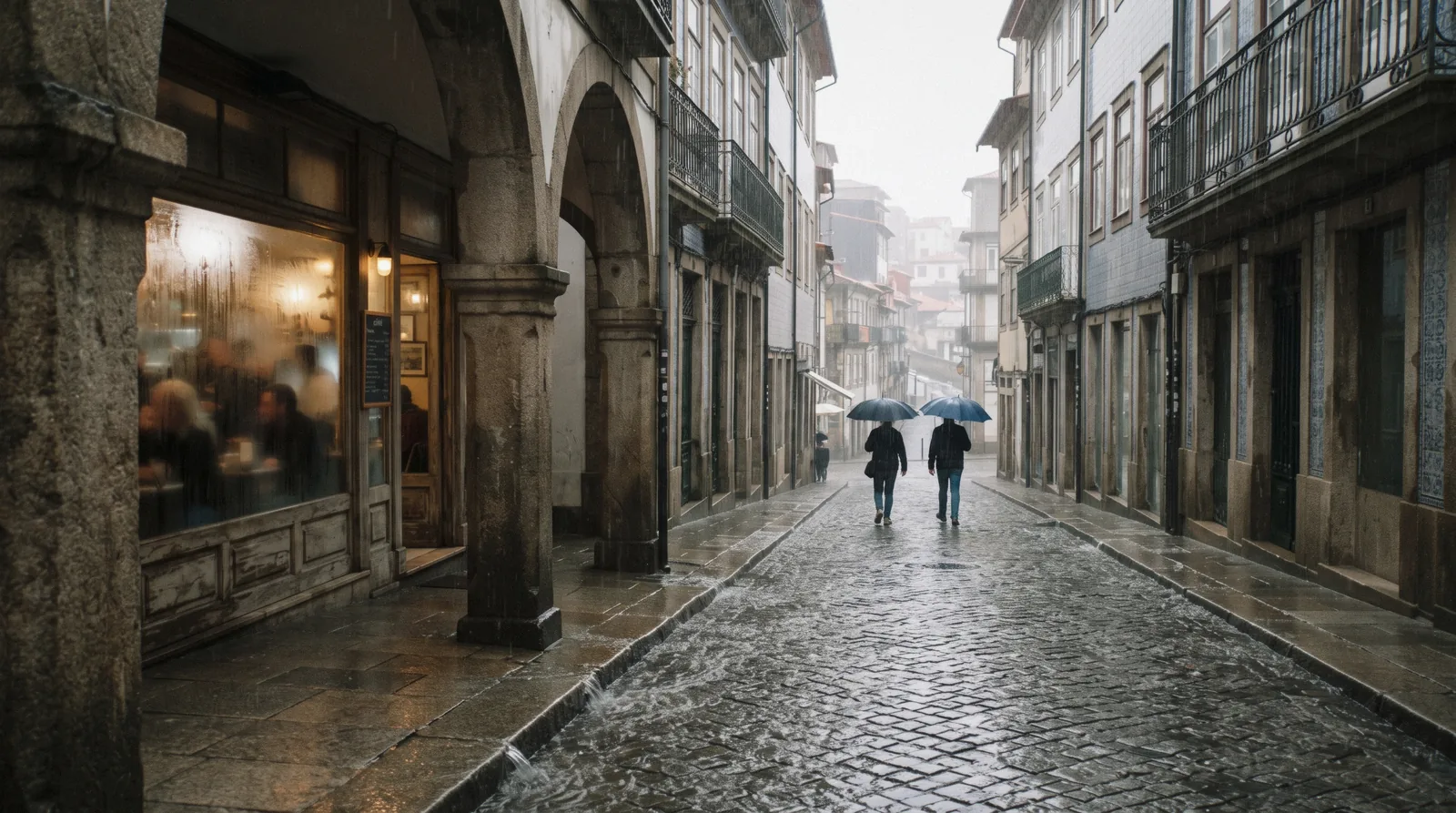
Porto Rainy Day: What the Rain Closes, What It Doesn't, and a Dry Route by the Hour
A Porto rainy day is not bad luck: the airport station's IPMA normals for 1991–2020 record 1,146.9 mm a year on 105 wet days, more than any other large Portuguese city, with 12 to 13 rainy days a month from November to January. The good news is that the city was built for it. The port lodges are cellars, the bookshop and the Bolsa are indoors, the market is roofed, the station hall is the point, and the metro runs 06:00–01:00 under all of it. What no guide admits is that not one venue in Porto publishes a wet-weather rule — no rain refund, no rain closure — so the plan has to come from geography rather than policy. This page prints the month table, says what the rain actually does to each sight, and builds a dry day hour by hour from doors that open every day, in dollars at €1 = $1.1622 with the euro beside them. The sun-and-crowd calendar lives on the best-time page; the family version of the indoor list on Porto with kids. Rain reorders a visit rather than cancelling it; for the dry-weather version, see what to do in porto.
Quick answer How wet Porto gets, what the rain closes, and the dry day in order
Porto is wet: 1,147 mm a year on IPMA's 1991–2020 normals, November the worst at 166 mm across 13 rainy days, July the driest at 17 mm across three. The rain closes nothing officially — no Porto venue prints a wet-weather rule — but it empties the outdoor half of the city: the bridge deck, the Ribeira terraces, the cable car's view and the Clérigos steps. The indoor half is the good half anyway. A dry day runs São Bento's tile hall to the Bolsa's Arab Room to a lodge cellar in Gaia to a museum, with the metro doing the moving, and costs $56.99 (€49) in official entries at most.
Key takeaways
- Book the indoor slot first: Taylor's cellars take walk-ins 10:00–18:15 with an audio guide and three ports, and the Cálem tour runs on a timed ticket — the wet route puts one of them at 14:00, after the Bolsa and before the museum
- The Palácio da Bolsa is the best wet-morning door in the centre: 30 minutes guided, $16.27 (€14), 9:00–18:30 daily; the cathedral guided tour covers the cloister under cover
- Skip on a wet day: the Six Bridges cruise (open deck, refund rule set by the operator, none printed), the cable car view and the Clérigos climb — the swaps table gives the dry trade for each
- Two museums shut on Monday whatever the weather — the Soares dos Reis and the Museu do Porto — so a wet Monday is lodges, churches and the stadium; the FC Porto museum is daily 10:00–19:00 and wheelchair-level throughout
How Often It Actually Rains in Porto
The figures are IPMA's 1991–2020 climate normals for Porto / Pedras Rubras, the airport station, published in 2024 — the only official thirty-year series for the city. There is no normal for the city centre; the airport sits 11 km north on the same coast.
Porto gets 1,146.9 mm of rain a year across 105.4 days with a millimetre or more. That is the wettest of Portugal's big cities by a clear margin, and it falls in a shape: the six months from October to March carry 817 mm between them, and the three summer months 80 mm. The rainiest month is November, 165.9 mm on 13 days; December at 153.3 mm and January at 151.0 mm are barely behind. The driest is July, 16.6 mm on three days, and August is 29.3 mm on three. So the question 'is Porto rainy?' has two answers: in summer, almost never — a July visitor has a one-in-ten chance of a wet day — and from late October to February, every other day or so, often for hours.
Why so wet: Porto faces the Atlantic at a latitude where the winter fronts that cross the ocean make landfall, and the Serra do Marão behind the city lifts them further — the Douro Valley 100 km inland is drier and hotter in every month, which is one reason the wine grows there and not here. The IPMA station has recorded 38.6°C on 7 August 2016 and −2.4°C on 13 January 2003, but the normal winter is mild and grey rather than cold: January's mean daily high is 14.0°C, the low 6.4°C. A wet Porto day in December is a wet London day with better cellars.
The practical reading: from November to February, plan every day with an indoor spine and treat sunshine as a bonus; from June to September, ignore this page unless the forecast is unusual; in the shoulder months, April at 95.5 mm on 10 days and October at 148.9 mm on 11, pack for both and read the forecast the night before.
Rain by Month: How Many Wet Days, How Much Water
IPMA 1991–2020 normals for Porto / Pedras Rubras: monthly rainfall, days with 1 mm or more, and the mean daily maximum temperature, with our reading of what the month feels like for a visitor. Read on in Q3 2026 from the IPMA climate-normal PDF.
| Month | Rain | Wet days | Average high | What a wet day is like |
|---|---|---|---|---|
| January | 151.0 mm | 12.8 | 14.0°C (57°F) | Grey and mild; the lodges and museums are empty and the light on the river is the best of the year between fronts |
| February | 97.8 mm | 10.0 | 15.0°C (59°F) | Showery; the driest winter month, and the cheapest for a room |
| March | 101.1 mm | 9.9 | 17.0°C (63°F) | Changeable; the tram and the gardens come back into play between showers |
| April | 95.5 mm | 10.4 | 18.1°C (65°F) | Ten wet days that rarely last the day; Easter fills the Clérigos night opening |
| May | 85.6 mm | 8.9 | 20.3°C (68°F) | Warm; Queima das Fitas week in the first half of the month is loud rather than wet |
| June | 33.7 mm | 4.9 | 22.7°C (73°F) | Dry; São João on the 23rd is an outdoor night and the fireworks have not been rained off in the record we could find |
| July | 16.6 mm | 3.1 | 24.3°C (76°F) | The driest month; three wet days in thirty |
| August | 29.3 mm | 3.2 | 24.8°C (77°F) | The warmest month; a summer storm passes in an afternoon |
| September | 68.2 mm | 5.8 | 23.5°C (74°F) | Still summer; the sea is at its warmest and the beach season runs to 13 September |
| October | 148.9 mm | 11.1 | 20.7°C (69°F) | The turn: the second-wettest month by volume, and the first with a full wet week |
| November | 165.9 mm | 13.0 | 16.8°C (62°F) | The wettest month; a wet day here means rain from breakfast to dinner |
| December | 153.3 mm | 12.4 | 14.7°C (58°F) | Wet and mild; the Christmas markets run under awnings until the end of the month |
Annual: 1,146.9 mm on 105.4 days, mean 15.3°C. Sea temperature: not stated — IPMA publishes no sea normal for Porto and we print no figure. The Fahrenheit figures are our conversions of the IPMA Celsius values.
What the Rain Actually Closes
Almost nothing, on paper. We read every venue page this site sources for a wet-weather clause in Q3 2026 and found none; what follows is what the rain does in practice, and the swap for each.
No Porto sight publishes a rain rule. The Gaia cable car prints one closed day a year, 25 December, and nothing about wind or rain; the Six Bridges cruise operators sell through the platforms, whose cancellation terms are the operator's own and say nothing about weather; the Clérigos tower prints last entry 30 minutes before closing and no weather clause; the Luís I Bridge closes to pedestrians for São João night and metro works, never for weather. So a wet forecast changes nothing you can claim a refund on.
It changes what is worth the money.
| Sight | Published wet-weather rule | What the rain does to it | Do this instead |
|---|---|---|---|
| Gaia cable car | None; closed 25 December only | Runs; the five-minute view is cloud and drips on the glass | Ride it on the first dry hour; the lodges beneath it are the wet-day reason to be in Gaia |
| Six Bridges cruise | None printed; cancellation terms are the operator's own | Open deck, wet benches, the bridges in murk | The Bolsa tour or a second lodge; book the sunset boat for a dry evening instead |
| Clérigos tower | None; last entry 30 minutes before closing | Wet stone stairs and no view from the top | The museum in the brothers' house is on the same $11.62 (€10) ticket and is indoors; climb another day |
| Luís I Bridge upper deck | Closed for São João night and metro works only | Exposed, windy, 45 m up; the lower deck has a pavement under the road deck | Cross by the lower deck, or ride metro line D across the top for $1.63 (€1.40) |
| Ribeira terraces and the Gaia quay | None | The tables come in; the arcades stay | Lunch inside; the Bolhão market restaurants are roofed and open to midnight |
| Palácio de Cristal gardens | None; open daily from 08:00 | Gravel paths, peacocks under the trees, nobody else | Go anyway between showers; the Soares dos Reis is next door when it starts again |
| Heritage tram line 1 | None; daily 08:40–20:43 | Runs, windows fogged; the riverside view goes | Ride it to the Tram Museum, which is indoors and 30% off with the ticket |
| Beaches at Foz and Matosinhos | Lifeguard season 13 June–13 September | Atlantic in a storm is the sight; the sand is not | The Foz promenade cafés face the surf; the beach page has the winter walk |
The one closure the rain has nothing to do with
Two things a wet-day planner keeps running into are shut for other reasons. The Funicular dos Guindais — the covered way up from the Ribeira to Batalha — is closed for maintenance on the operator's page in Q3 2026 with no reopening date, so the wet climb is stairs or the bus. And the Serra do Pilar monastery, the roofed dome with the best view over the bridge, is closed for works with no date either; the culture ministry's page still prints hours and a €2/€4 ticket, and neither is currently real.
Your Wet Day, Hour by Hour
Built from doors that are indoors and open daily, in the order that keeps you under cover, with the metro doing the crossings. Walk minutes are our estimates; hours and prices from the venues' pages in Q3 2026. It works on a Monday if you swap the museum for the stadium.
09:00 — São Bento to the Bolsa
Start under the roof that is the sight: the tile hall at São Bento station is free, open with the trains, and at 9:00 you have it to yourself. From the station it is 400 metres down Rua de Mouzinho da Silveira — a straight ramp, the only street in the centre that is neither steps nor setts — to Rua Ferreira Borges and the Palácio da Bolsa. The $16.27 (€14) visit is a mandatory 30-minute guided tour in whichever language the desk assigns by arrival order; at 9:30 on a wet Tuesday the group forms in minutes.
The Arab Room is the point, and it is indoors. Next door, São Francisco opens at 9:00 with its gilt interior and catacombs on one ticket whose price its new official site does not print, so we do not either.
11:00 — Lello, or the cathedral, under cover
Two options for the late morning, both roofed. If you hold a Livraria Lello voucher — $18.54 (€15.95), credited against a Lello Editions book — this is its hour; the queue outside is the only wet part, and on a wet day it is shorter. If not, the cathedral is five minutes up from São Bento: the $3.49 (€3) ticket covers the cloister, whose Gothic arcade is roofed, the museum and the tower, which you skip.
The guided tour with entry tells the story of the fortress-church in an hour without you reading a wet panel. Between the two, the Capela das Almas tiles on Rua de Santa Catarina are seen from under the shop awnings opposite.
12:30 — Bolhão, roofed
The Bolhão market is the wet lunch: a roofed hall of stalls with restaurants on the upper floor open 8:00–24:00, Monday to Saturday, ten lifts, four entrances — and the best pastry counters in the centre. Closed Sunday, in which case the arcades of the Ribeira or the Via Catarina centre on the same street take its place. From Bolhão the metro at Bolhão station is level-access.
14:00 — a cellar in Gaia
The lodges are cellars, which is to say they are the wettest-proof rooms in the city, and the crossing is dry if you do it right: metro line D from Bolhão or São Bento to Jardim do Morro crosses the top deck of the Luís I Bridge inside a train, $1.63 (€1.40) on a Zone 2 title, and the cable car beside the station drops you on the quay under glass for $8.14 (€7). Taylor's takes no booking — cellars 10:00–18:15, $29.10 (€25) with the audio guide and three ports, the walk-in ticket is the same product — and its terrace at the end has a roof. Cálem on the quay is a timed guided tour at $25.60 (€22) for the classic visit, booked on the timed ticket. World of Wine, the roofed museum quarter above the quay, would be the obvious wet afternoon, but its site refused every fetch and we have no official price to print; the platform lists its wine experience at $23.23 (€20).
16:30 — a museum, then the metro home
Back over the bridge by metro to Trindade and the yellow line's connection, or two stops on to São Bento and a bus. The wet-day museums: the Soares dos Reis on Rua de D. Manuel II, $11.62 (€10), Tuesday to Sunday to 18:00; the Museu do Porto spaces at $4.65 (€4) each or $9.30 (€8) for a seven-day ticket, to 17:30; the Tram Museum at $9.30 (€8) to 18:00, reached dry by tram 1 along the river. On a Monday all three are shut and the FC Porto museum is the replacement — daily 10:00–19:00, $29.10 (€25) with the self-guided stadium tour, wheelchair-level and therefore dry-shoed throughout, on metro line F at Estádio do Dragão.
Dinner is the where-to-eat page; the evening, if it clears, is the sunset cruise with a deck that has a canopy.
Where the Covered Walking Is
Porto has no Bolognese arcades, but it has three kinds of dry ground, and knowing them is the difference between a wet day and a soaked one.
The metro is the arcade. Six lines, 06:00–01:00, level-access stations, and the yellow line D does the one thing that matters on a wet day: it crosses the river inside a train on the top deck of the Luís I. São Bento, Aliados, Trindade, Bolhão and Jardim do Morro are the five stations a visitor uses, and all five are within 200 metres of a sight on this page. An Andante card is $0.70 (€0.60) from any machine; the Zone 2 single $1.63 (€1.40) covers an hour of changes; the 24-hour Zone 2 ticket at $6.22 (€5.35) pays for itself on the fourth ride, which is roughly the wet route above. The transport page has the zones.
The interiors are large. The Bolsa, São Francisco, the cathedral cloister, the Bolhão hall, the São Bento concourse, the lodges' cellars and tasting rooms, and the Via Catarina shopping centre on Rua de Santa Catarina are each a dry half hour or more, and they sit in two clusters — the Ribeira-side cluster around Rua Ferreira Borges and the Baixa cluster around Santa Catarina — with Mouzinho da Silveira's straight ramp linking them.
The streets to prefer. Mouzinho da Silveira rather than the Barredo steps between São Bento and the Ribeira; Rua de Santa Catarina's shop-front awnings rather than the open Aliados for the walk to Bolhão; the lower deck of the bridge, whose pavement runs under the upper deck's iron, rather than the top. The granite setts are the hazard nobody prints: polished by a century of feet, they are slippery when wet in a way tarmac is not, and the safety page rates them above pickpockets as the thing that actually hurts visitors.
The Wet-Weather Trades
What you had planned, what the rain does to it, and the dry trade that keeps the day's shape — each pair drawn from the venue hours and prices above, read in Q3 2026.
| What you planned | What the rain does | Swap it for | Why that works |
|---|---|---|---|
| Clérigos tower climb | Wet stairs, no view | The Clérigos museum on the same ticket, then the Bolsa | Both indoors; the tower keeps for a dry hour before 19:00 |
| Six Bridges cruise | Open deck, no refund rule printed | Taylor's or Cálem cellars in Gaia | Cellars are the driest rooms in the city, and the crossing by metro is inside a train |
| Cable car for the view | Cloud on the glass | Cable car as transport, down to the quay | Five minutes, $8.14 (€7), and it drops you at the lodge doors |
| Ribeira lunch on the quay | Tables come in | The Bolhão upstairs restaurants, 8:00–24:00 | Roofed, lifts, and open every day but Sunday |
| Foz beach and the tram ride | Atlantic storm; tram windows fogged | The Tram Museum by tram 1, 30% off with the tram ticket | The ride is still the ride, and the museum is dry |
| Douro Valley day tour | Vineyards in cloud, boat deck wet | Coimbra's Joanina library or the Guimarães palace | Both indoors; Joanina is timed at the printed minute, so the train, not the bus |
Nothing in this table needs cancelling: no Porto venue prints a rain rule, so the planned things simply move to a dry hour.
Day Trips in the Rain
The valley is the wrong wet day and the university is the right one. What each day-trip sight's own page says, read in Q3 2026.
The Douro Valley is an outdoor day — terraces, a boat deck, a quinta's vineyard walk — and the boat-and-lunch tours run in any weather with the operator's own cancellation rule and no printed rain clause. In cloud the terraces are lost; save it. Coimbra is the wet day's trip: the self-guided programme that includes the Biblioteca Joanina, the university and the science museum is $19.18 (€16.50), the guided Paço das Escolas visit $29.10 (€25) at 11:00 and 15:00, and the library admits at the minute printed on the ticket, non-refundable, sold up to three months ahead — take the train, not a bus that might be late. Guimarães is half and half: the Paço dos Duques at $5.81 (€5) is a roofed palace, the castle at $5.81 (€5) is walls in the rain and its keep is closed for works anyway. Braga's Bom Jesus is the funicular ($2.91 / €2.50 one way) and a hillside staircase you climb in the wet or not at all; the basilica is free and roofed. Aveiro is canals from an open boat — no. Santiago de Compostela is the one outside-Portugal option: the cathedral is 7:00–21:00 daily and free, the Pórtico da Gloria a timed $17.43 (€15) visit of 25 minutes, and Galicia is wetter than Porto, which at least makes it honest. The day-trips hub prints the train fare beside each tour price.
Umbrellas, Cloakrooms and Drying Out
The small things, most of them unprinted by any official page and marked as such.
Umbrellas: the Atlantic wind that brings the rain also inverts umbrellas on the bridge and the Ribeira; a hooded shell coat is the local answer, and the November visitor in a cotton jacket is the one shivering in the lodge queue. Cloakrooms: no venue on this page prints a cloakroom or a bag rule — Lello, the Bolsa and the lodges say nothing — so assume none and carry small. Shoes: the granite setts are the hazard; soles with grip matter more than waterproofing. Drying out: the lodges' tasting rooms, the Bolhão upstairs and the Majestic (Monday to Saturday 9:00–23:00, no prices printed) are the warm rooms; the metro stations are dry but not warm.
Taxis and apps exist but no official page prints a tariff, so we print none; the metro is the reliable wet-day mover and runs to 01:00. If the day is a washout from the start, the two things that reward a whole wet day are a lodge with a booked lunch — Graham's sells a visit with lunch at €140 booked 48 hours ahead — and the FC Porto museum, which is level-access, daily and at the end of a metro line. And if you are here with children, the kids page marks which of these doors take a pushchair, which is most of the wet ones.
The Rain in the City's Own Story
Porto's weather is not incidental to what it built; a short section on why the wet city looks the way it does.
The granite is the rain's first consequence: a soft stone would not have lasted a century of 1,100-millimetre winters, so the city is grey by material rather than by mood, and the setts you slip on were laid because they drain. The azulejo tile is the second — the glazed façades of the Capela das Almas, the São Bento hall and the Carmo church are weather-cladding as much as decoration, a surface that sheds water and does not stain. The port trade is the third: the wine was made 100 km up a drier valley and brought down the river to age in cellars on the Gaia bank, where the Atlantic damp keeps a cellar at the cool, even temperature that a tawny wants — the lodges you shelter in on a wet afternoon are there because of the weather you are sheltering from.
Even the Luís I Bridge belongs to the story: its 1886 iron replaced a suspension bridge, and that bridge had replaced the pontoon of boats that broke on 29 March 1809 under a crowd fleeing the French — the 1809 disaster post tells it — on a river that in flood is the rain arriving from the whole valley at once.
The Indoor Bookings Worth a Fixed Slot
Six tickets for doors that stay dry: two cellars, the wine museum quarter, the stadium, the bookshop voucher and the cathedral with a guide. Prices and ratings as listed by the operator in Q3 2026; the official price beside each is on the tickets index.
 from €25
Porto: Taylor's Port Cellars & Tasting
listed at $29.03
Taylor's self-guided cellar visit with a QR-code audio guide in 13 languages and three glasses at the end, plus grape juice for children. Bring headphones; the masterclass options need 24 hours' notice.
Check Availability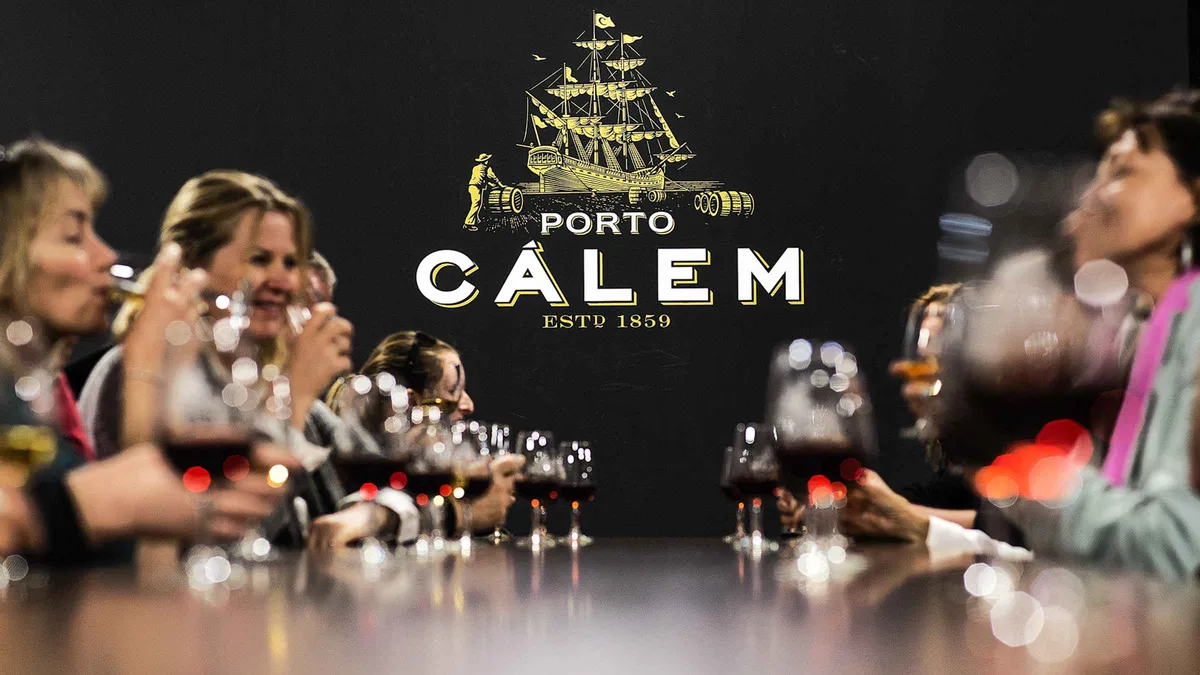 from €22
Porto: Cálem Cellar Tour, Interactive Museum & Wine Tasting
listed at $25.55
The riverfront Cálem cellar: a 15-minute interactive museum, a half-hour guided tour in four languages and two ports at the end. Short, cheap and central — pick it when time is tight.
Check Availability from €20
Porto: Port & Wine Experience, Best Wine Museum in the World
listed at $23.23
The single-museum WOW ticket: the Wine Experience with an audio guide in seven languages and three wines at the end, or a non-alcoholic alternative. Enough for one afternoon; the day pass covers five museums.
Check Availability from €17
FC Porto: Museum & Tour
listed at $19.74
Self-guided museum plus a stadium walk-through at the Dragão, with audio guides in six languages. Stadium access drops out on match days and UEFA match eves, when only the museum ticket is sold.
Check Availability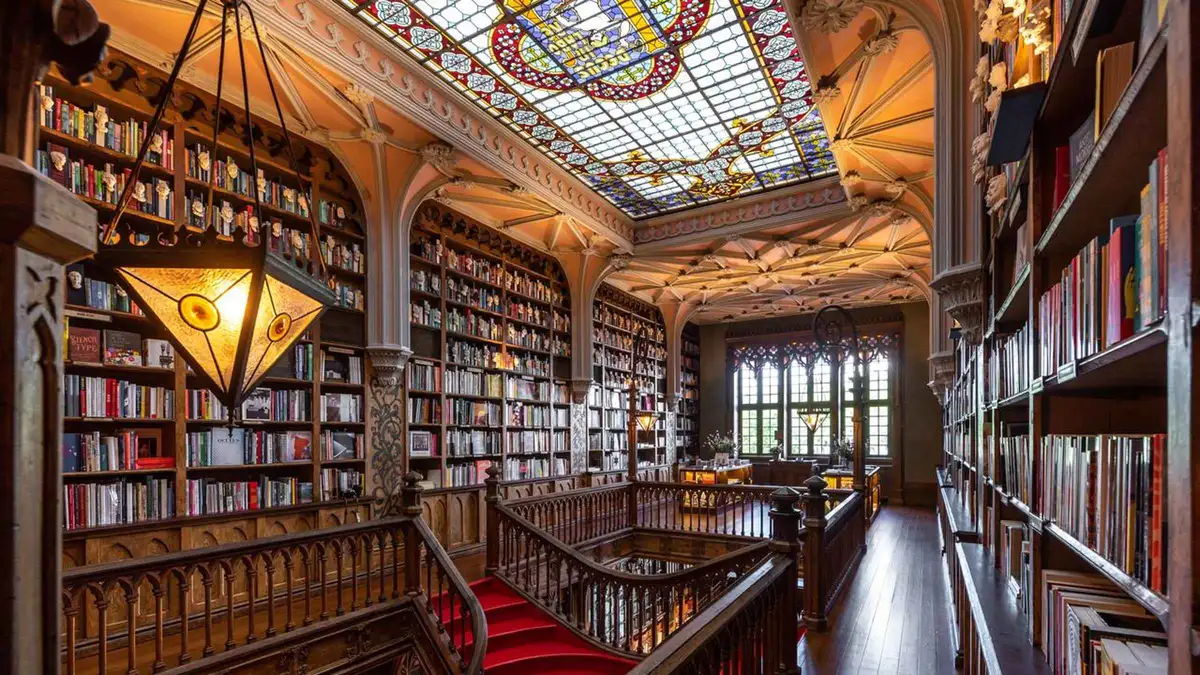 from €30
Porto: Livraria Lello Entry Ticket & Foundation Combo Ticket
listed at $34.78
Timed entry to the Lello bookshop bundled with the Lello Foundation in a renovated monastery 8 km out of town. Non-refundable, and the Foundation is closed Monday and Tuesday, so pick the date carefully.
Check Availability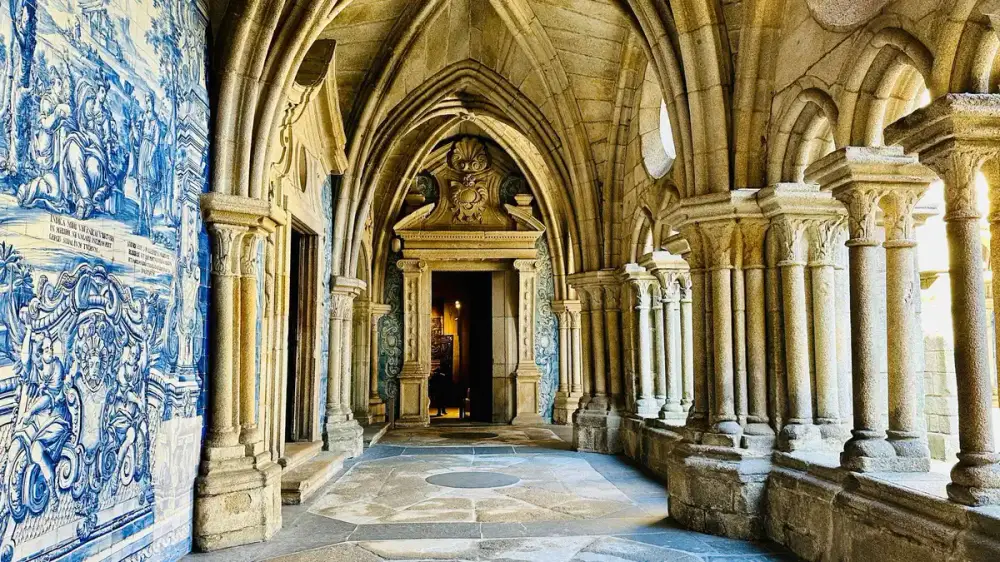 from €16
Porto Cathedral Guided Tour with Entrance Tickets
listed at $18.77
One hour inside the Sé with a certified guide, cloisters and Cabido House included, and a Bishop's Palace add-on every day except Sunday. The cheapest way to have the cathedral explained rather than just walked through.
Check AvailabilityPrices, ratings and details are the platform's own. Dollar figures are the listed prices. The platform bills in your account's currency.
Map: the Wet-Day Route
The wet route in order, with the metro stations that link its two halves. Coordinates are the venues' Wikidata points; the metro stops are placed at their street entrances.
Metro station pins are our placements at the street entrances; venue pins are Wikidata coordinates. The Taylor's pin is placed on Rua do Choupelo from its printed address. Tiles from OpenStreetMap.
Rain in Porto: the Questions
What is there to do in Porto when it rains?
The indoor half of the city, which is the better half: the São Bento tile hall, the Palácio da Bolsa's 30-minute guided tour at $16.27 (€14), the cathedral cloister, the Bolhão market's roofed restaurants, a lodge cellar in Gaia — Taylor's takes walk-ins — and a museum, with the metro crossing the river inside a train. The wet route puts them in order.
What is the rainiest month in Porto?
November, at 165.9 mm on 13 rainy days on IPMA's 1991–2020 normals; December (153.3 mm) and January (151.0 mm) are close behind, and October at 148.9 mm is the first wet month. July is the driest at 16.6 mm on three days. The full month table is above, and the best-time page turns it into a month choice.
Is Porto rainy?
Porto is rainy by Portuguese standards and not by northern European ones: the IPMA 1991–2020 normal for the city records 1,146.9 mm of rain across 105.4 days with at least a millimetre, against Lisbon's drier year. The rain is concentrated, not constant — November averages 165.9 mm over 13 days, while July averages 16.6 mm over three, so a summer visit is effectively dry and a November one needs the indoor plan on this page. See the month-by-month table and the best time to visit.
Why is Porto so rainy?
It faces the Atlantic where the winter fronts land, and the hills behind it lift them: 1,146.9 mm a year at the airport station, more than any other large Portuguese city, with 817 mm of it between October and March. The Douro Valley 100 km inland is drier in every month, which is why the wine is grown there and aged here.
Do Porto's sights close when it rains?
No — not one venue we source publishes a wet-weather closure or refund. The Gaia cable car prints 25 December as its only closed day, the cruises leave cancellation to the operator, and the bridge closes for São João night and metro works, not weather. What the rain does is make the outdoor half not worth its price; the swaps table gives the dry trade for each.
Does a wet forecast spoil the trip?
Yes, with an indoor spine to every day. November to February bring 12 to 13 wet days a month but mean daily highs of 14–17°C, empty lodges and museums, the cheapest rooms of the year and the best river light between fronts. Pack a hooded coat rather than an umbrella — the wind on the bridge inverts them — and shoes with grip for the granite.
Can you do a Douro Valley tour in the rain?
You can — the boat-and-lunch tours run in any weather and print no rain rule — but the terraces are the sight and cloud removes them. On a wet forecast swap it for Coimbra, where the Joanina library is a timed indoor visit on the $19.18 (€16.50) self-guided programme, or the Guimarães palace at $5.81 (€5).
What works indoors when you have children and rain?
The Bolhão market (lifts, roofed, pastry), the FC Porto museum (daily, level-access, self-guided, $15.11 / €13 for a child of 5 to 12), the Tram Museum by tram 1 (free under 6) and the metro ride over the bridge. The kids page marks which doors take a pushchair; most of the dry ones do.
Plan Around the Weather
The three pages that finish a wet forecast.
Best time to visit Porto
The same IPMA normals as a season chart, with the crowd calendar and the events laid over them. When to visit.
The month chooserPorto port wine cellars
Every lodge compared: which takes walk-ins, which needs a reservation, what the tasting includes and what a child pays. The cellars.
The driest rooms in the cityPorto museums
The Soares dos Reis, the Museu do Porto seven-day ticket, Serralves at $27.90 (€24) for all its spaces, free on the first Sunday of the month, and the Tram Museum, with the Monday rule and the free-day truth. Porto museums.
Tuesday to SundayPorto in the Rain on Video
Three wet-day films: a local's list of indoor things and the mistakes to avoid, a seven-stop dry itinerary, and a walk through the Baixa in the rain so you can see what the granite looks like wet. Prices on camera are from their filming dates; ours are in Q3 2026.
15 Best Things to Do in Porto on a Rainy Day (Avoid the Rookie Mistakes!)
A Porto guide's indoor list — the lodges, the museums and the market appear in roughly the order this page uses.
Video: PortoalitiesRainy Day In Porto? 7 Must-do Places To Visit To Stay Dry!
Seven roofed stops, most of them on the wet route above.
Video: Activities In PortugalPORTO PORTUGAL: Rainy Day City Walking Tour | 4K 60fps
The Baixa and the Ribeira in real rain, useful for seeing the setts, the awnings and the covered ground this page describes.
Video: Virtual StrollsVideos load from YouTube only when you press play.
Prices, hours and terms are set by the venue or operator and confirmed at checkout.
We may earn a commission if you book through one of our links, at no extra cost to you. Full affiliate disclosure